|
|
|
|
|
 CMP Employee “Jailed” CMP Employee “Jailed”
for Muscular Dystrophy Association
-
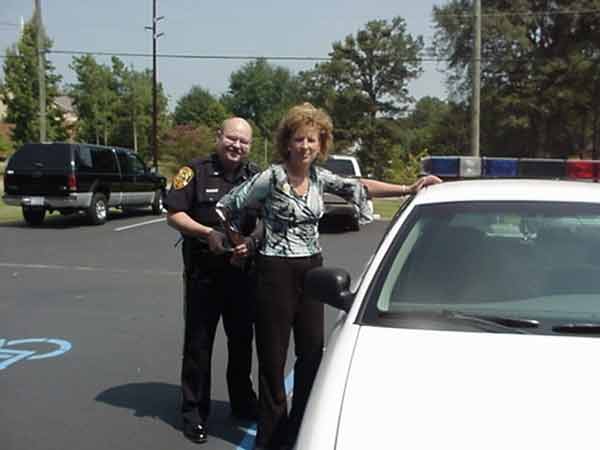
Recently, there was a slight disturbance at CMP South Headquarters in Anniston, Alabama. It seems that the Civilian Marksmanship Program had been harboring a person of questionable character for quite some time.
|
|
 Marine
Corps Junior Highpower Rifle Clinic Marine
Corps Junior Highpower Rifle Clinic
Developing Excellence through Education
- Walking into the Marine Corps Junior Highpower Rifle Clinic,
it was immediately apparent that things will be done only one
way throughout the three days of the course…the Marine way.
It is also immediately clear from the popularity of this
annual junior clinic which starts the National Trophy Rifle
Matches week that the young people who attend like doing
things the Marine Corps way.
|
|
|
|
|
Staff
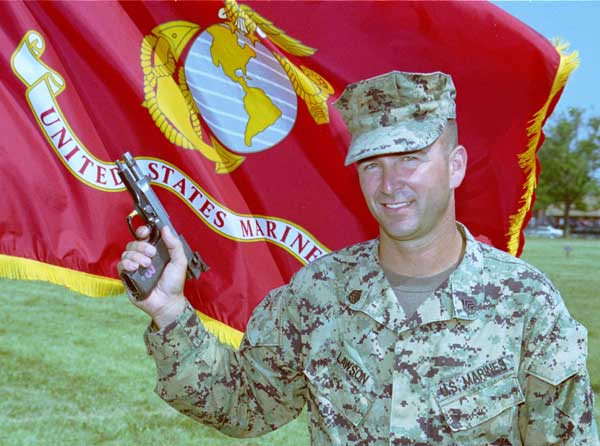
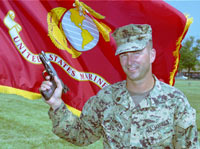
Sergeant Michael Lawson, USMC, won the Presidents Pistol
Match with a score of 387-11X.
|
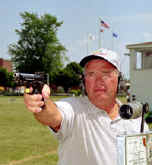
Steve
Reiter,
Sparks
,
Nevada
, won the National Trophy Individual Pistol Match with a
score of 294-11X.
|
|
|
National Pistol Matches Close with Drama and New National Champions
- As quick as
the wind coming off of the water of Lake Erie, the first stage
of the National Rifle and Pistol Matches at Camp Perry have
drawn to a close. With the CMP National Trophy Pistol Matches,
and the awards ceremony that followed, pistol shooters from
all over the country departed Camp Perry and left it to the
smallbore shooters who will gather here in the coming
days…but not before new National Champion pistol shooters
were crowned and trophies presented.
|
|
Pistol
Competitor Killed in Tragic Accident
Returning Home from Camp Perry -
In a community as large as the competitive shooting family
that comes to the National Matches at
Camp
Perry
every year, tragedies that strike one of their members are
always hard to take. On Wednesday, July 21st, Ken
Saucier, a pistol shooter, Seattle Police Officer and father,
died in a single-car accident in
Northern Idaho
. Mr. Saucier was en route home to
Seattle
after attending the 2004 National Pistol Matches at Camp
Perry.
|
|
Rimfire
Sporter Story
- For shooters new to the competition world, coming to Camp
Perry can be daunting. Many think that you have to be a
potential national champion to compete here. However,
nothing could be farther from the truth. To encourage
more people to try target shooting and come to the National
Matches, the CMP created the Rimfire Sporter Match in 2002.
On July 24th, 143 Rimfire Sporter shooters experienced why
Camp
Perry
is considered one of the most challenging places to shoot in
the United States
– wind!
|
|
Camp
Perry
Eagles Update -
The pair of eagles that nest on Camp
Perry have become well-known to the shooters who come to the
National Matches. Last year, the pair fledged two young
eagles that frequently flew over the ranges and occasionally
caused “cease fires” long enough for Camp Perry Range
Operations staff to chase them out of harms way in the range
impact areas. The Camp
Perry
eagles hatched one new eaglet this year that was banded by
Ohio DNR Division of Wildlife staff on May 28, 2004. To
see a series of photos and captions of the 2004 eagle banding
at Camp
Perry, click here.
|
|
 Champion
Marine Corps Marksman Launches 2nd Century of National Matches
-
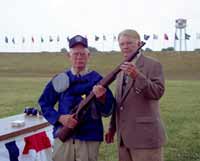
Olympic silver medalist and many-time national champion Jim Hill was the guest of honor at the 2004 National Matches First Shot Ceremony on July 12 at Camp Perry, Ohio. Hill, a retired Marine, was invited by the CMP to be the First Shot Ceremony speaker and fire the ceremonial first shot that inaugurates each annual National Matches. Champion
Marine Corps Marksman Launches 2nd Century of National Matches
-
Olympic silver medalist and many-time national champion Jim Hill was the guest of honor at the 2004 National Matches First Shot Ceremony on July 12 at Camp Perry, Ohio. Hill, a retired Marine, was invited by the CMP to be the First Shot Ceremony speaker and fire the ceremonial first shot that inaugurates each annual National Matches.
|
|
 Nebraska
4-H Team Dominates Junior Olympic Sporter
-
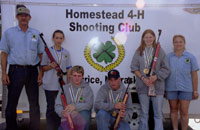
The
leading team in the 2004 National Junior Olympic
Three-Position Air Rifle Championship was the
Homestead
4-H Shooting Club from Beatrice Nebraska. The
Nebraska
team’s rise to the top is part of a dramatic change in which
parts of the country produce the best sporter class
three-position air rifle shooters. Just two or three
years ago, most winning sporter juniors hailed came from the
southeast U. S. In the 2004 championship seven of the
top eight individuals came from the Plains states of
Nebraska, South Dakota, Kansas, Oklahoma
and
Minnesota, while only one came from a southern state,
Louisiana
. Nebraska
4-H Team Dominates Junior Olympic Sporter
-
The
leading team in the 2004 National Junior Olympic
Three-Position Air Rifle Championship was the
Homestead
4-H Shooting Club from Beatrice Nebraska. The
Nebraska
team’s rise to the top is part of a dramatic change in which
parts of the country produce the best sporter class
three-position air rifle shooters. Just two or three
years ago, most winning sporter juniors hailed came from the
southeast U. S. In the 2004 championship seven of the
top eight individuals came from the Plains states of
Nebraska, South Dakota, Kansas, Oklahoma
and
Minnesota, while only one came from a southern state,
Louisiana
.
|